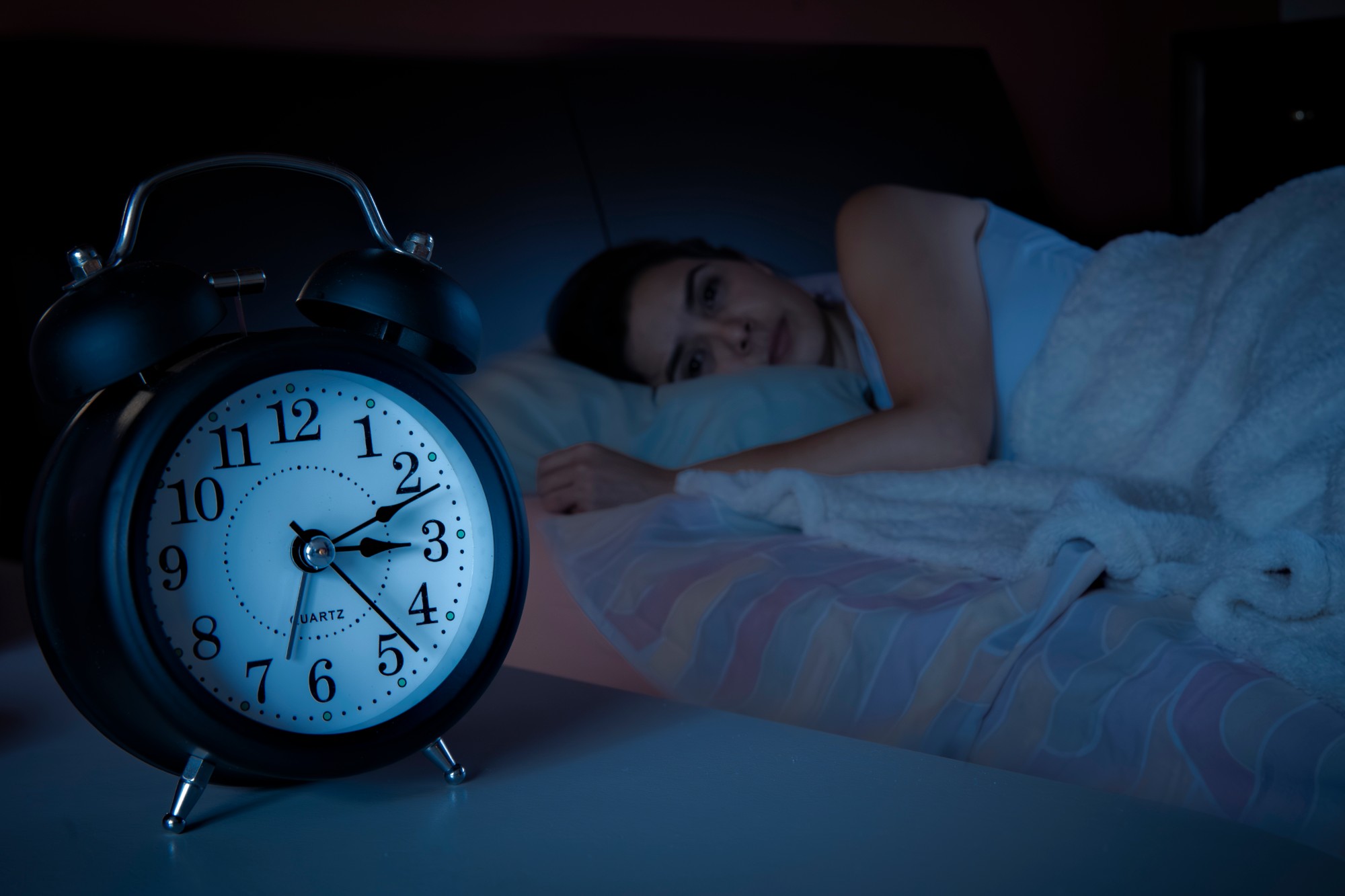
You fall into bed exhausted. You close your eyes. And then — nothing.
Or worse: you fall asleep in minutes and wake at 3 a.m. with your mind racing and your heart going, and you lie there doing arithmetic about how many hours are left. By morning you feel like you ran a marathon lying still. By two in the afternoon the fatigue is heavy enough that forming a sentence takes effort.
You have tried melatonin. You have cut caffeine. You have gone to bed earlier, put the phone in another room, bought the weighted blanket.
Here is what is usually missing from that conversation: your hormones are part of your sleep, and they change — across the month, and across the decade.
The short answer
Progesterone and estrogen both shape how you sleep. Progesterone has a calming effect on the brain; estrogen is involved in temperature regulation, REM sleep, and the stress response. When either one drops or swings — in the week before your period, after birth, or through perimenopause — sleep often goes with it. This can happen without night sweats and without any of the "classic" signs people associate with menopause, which is one reason it gets missed.
Is it actually more common in women, or does it just feel that way?
It is more common.
A meta-analysis of sex differences in insomnia found a pooled risk ratio of 1.41 for women compared with men — roughly a 40% higher risk (Zhang & Wing, Sleep, 2006). A 2020 systematic review reached the same conclusion using a different measure.
And it rises as hormones shift. The Study of Women's Health Across the Nation (SWAN) followed 3,045 women through the menopausal transition. At baseline, 28.0% of premenopausal women reported difficulty sleeping at least three times a week. Among early perimenopausal women, it was 34.3% (Kravitz et al., Sleep, 2008).
So if sleep got harder and nothing else in your life changed, that is a documented pattern, not a personal failing.
What progesterone has to do with it
Progesterone rises in the second half of your cycle — the luteal phase — and falls just before your period starts. It has a calming, sedative-like action in the brain.
When it drops, that buffer drops with it. This is why some women can predict their worst nights by the calendar: the three or four nights before bleeding starts are reliably the thinnest sleep of the month.
In perimenopause, progesterone declines overall, and the predictable monthly pattern stops being predictable. The buffer is not just lower; it is inconsistent, which is harder to plan around.
What estrogen has to do with it
Estrogen is involved in regulating body temperature, REM sleep, and the body's stress response system.
When it fluctuates sharply — as it does in perimenopause, where the pattern is swings rather than a smooth decline — sleep architecture is disrupted. Sleep architecture is the structure of a night's sleep: the order, length and depth of the stages you cycle through. You can be in bed for eight hours and still get a poor night of it, because the shape of the sleep was wrong.
This is the part that surprises people: it happens without hot flashes. Plenty of women assume that no night sweats means no hormonal involvement. That is not what the pattern looks like.
Why the tiredness feels different from ordinary tiredness
Because it is a different thing. Ordinary tiredness resolves with rest. This does not.
The description women give is remarkably consistent: bone-deep fatigue combined with an inability to actually rest. Wired and exhausted at the same time. Falling asleep on the sofa at nine and being wide awake at eleven.
What does this have to do with my mental health?
More than most people are told.
Sleep and mental health run in both directions. Poor sleep is a symptom of anxiety and depression, and it is also a contributor to them. Without enough sleep, your brain's capacity to regulate emotion, manage stress and process difficult experiences is measurably reduced.
You are not less resilient than you were. You are working with a compromised toolkit.
This is why Mamaya Health treats sleep as a mental health issue rather than a lifestyle one. Our clinicians ask about sleep as part of every picture, because treating anxiety or depression without looking at sleep is bailing water out of a boat that is still leaking.
What hormone data can and cannot tell you
This is where our partner Oova comes in, and it is worth being precise about what it does.
Oova's at-home tests let you track your hormone levels day to day — when progesterone is low, when LH is surging — and see how those patterns line up against your worst nights.
What that gives you is information, not a treatment. The value is that you walk into an appointment with a record instead of an impression. "I sleep badly sometimes" is hard for any clinician to work with. "These are my hormone levels and these are the nights I woke at three" is a different conversation.
What you do with that information is a decision for you and your clinician. There are several directions it can go, and the right one depends on your history, your other symptoms and what you are trying to treat. We are not going to tell you what it is in a blog post, and you should be cautious of anyone who does.
When to raise it with someone
Worth a conversation if any of these are true:
- Sleep has been difficult for more than a few weeks and has not improved with the obvious adjustments
- You wake in the early hours regularly and cannot get back down
- The tiredness is affecting your work, your relationships, your driving or your patience
- Your mood has shifted alongside the sleep
- You can predict your bad nights from where you are in your cycle
That last one is useful information for a clinician, so bring it if you have it.
Quick reference
| When | What is happening | What it often looks like at night |
|---|---|---|
| Week before your period | Progesterone falling | Harder to fall asleep; lighter sleep for 3–4 nights |
| After birth | Steep hormonal drop plus a feeding schedule | Broken sleep, difficulty sleeping even when the baby does |
| Perimenopause | Estrogen swinging; progesterone declining | 3 a.m. waking, unrefreshing sleep, with or without night sweats |
| Any of the above | Sleep loss affecting mood regulation | Shorter fuse, flatter mood, feeling "less resilient" |
Where to start
If sleep is affecting your mental health, your relationships, your work or your quality of life, you deserve more than "try melatonin and practice good sleep hygiene."
Mamaya Health's clinicians can help you untangle the hormonal and mental health threads around your sleep. Oova can give you the hormone data to bring to that conversation.
Ready to sleep again? Connect with a Mamaya Health clinician at mamayahealth.com, or explore your hormone patterns at oova.life.
If you are struggling with your mental health, you do not have to wait for a crisis to ask for help. If you are in one: call or text 988, reach the National Maternal Mental Health Hotline at 1-833-852-6262, or text HOME to 741741.
This article is for information and is not medical advice. It does not replace an assessment by your own clinician.
Sources
- Zhang B, Wing YK. Sex differences in insomnia: a meta-analysis. Sleep. 2006;29(1):85–93. doi:10.1093/sleep/29.1.85
- Kravitz HM, Zhao X, Bromberger JT, et al. Sleep disturbance during the menopausal transition in a multi-ethnic community sample of women. Sleep. 2008;31(7):979–990. (Study of Women's Health Across the Nation, n = 3,045.)
- Zeng L-N, et al. Gender difference in the prevalence of insomnia: a meta-analysis of observational studies. Frontiers in Psychiatry. 2020;11:577429.
Common questions
- Why am I exhausted all day but wide awake at night?
- Daytime exhaustion with night-time alertness is a common pattern when sleep is fragmented rather than short. You may be getting hours without getting the structure — the stages of sleep your brain needs to come out rested. Hormonal shifts across the cycle and through perimenopause are one well-documented contributor.
- Why do I wake up at 3 a.m. every night?
- Early-hours waking is one of the most frequently reported sleep changes in perimenopause. It can occur with or without night sweats. It is also associated with anxiety and depression, which is why it is worth raising with a clinician rather than treating as a quirk.
- Can hormones affect sleep even if I'm not in menopause?
- Yes. Progesterone rises and falls across every cycle, and many women find the nights before their period are reliably their worst. The same mechanisms operate; the difference is that in perimenopause the pattern stops being predictable.
- Can I have hormone-related sleep problems without hot flashes?
- Yes. Many women assume no night sweats means hormones are not involved. Sleep disruption in perimenopause occurs in women who never have a hot flash.
- Does melatonin fix this?
- Melatonin addresses sleep timing. It does not address a progesterone drop or an estrogen swing. If melatonin has not worked for you, that is information, not a failure to use it properly.
- How do I know if it is my hormones or my mental health?
- Often it is both, and they feed each other. That is why they are best assessed together rather than one at a time.
- What should I bring to an appointment?
- Anything you have tracked: which nights were bad, where you were in your cycle, what else was happening. Hormone data from a tool like Oova gives a clinician a clearer starting point than memory does.
- Is this just part of getting older?
- Age is a factor. It is not an explanation, and it is not a reason to accept it. Sleep that is affecting your life is worth assessing whatever your age.