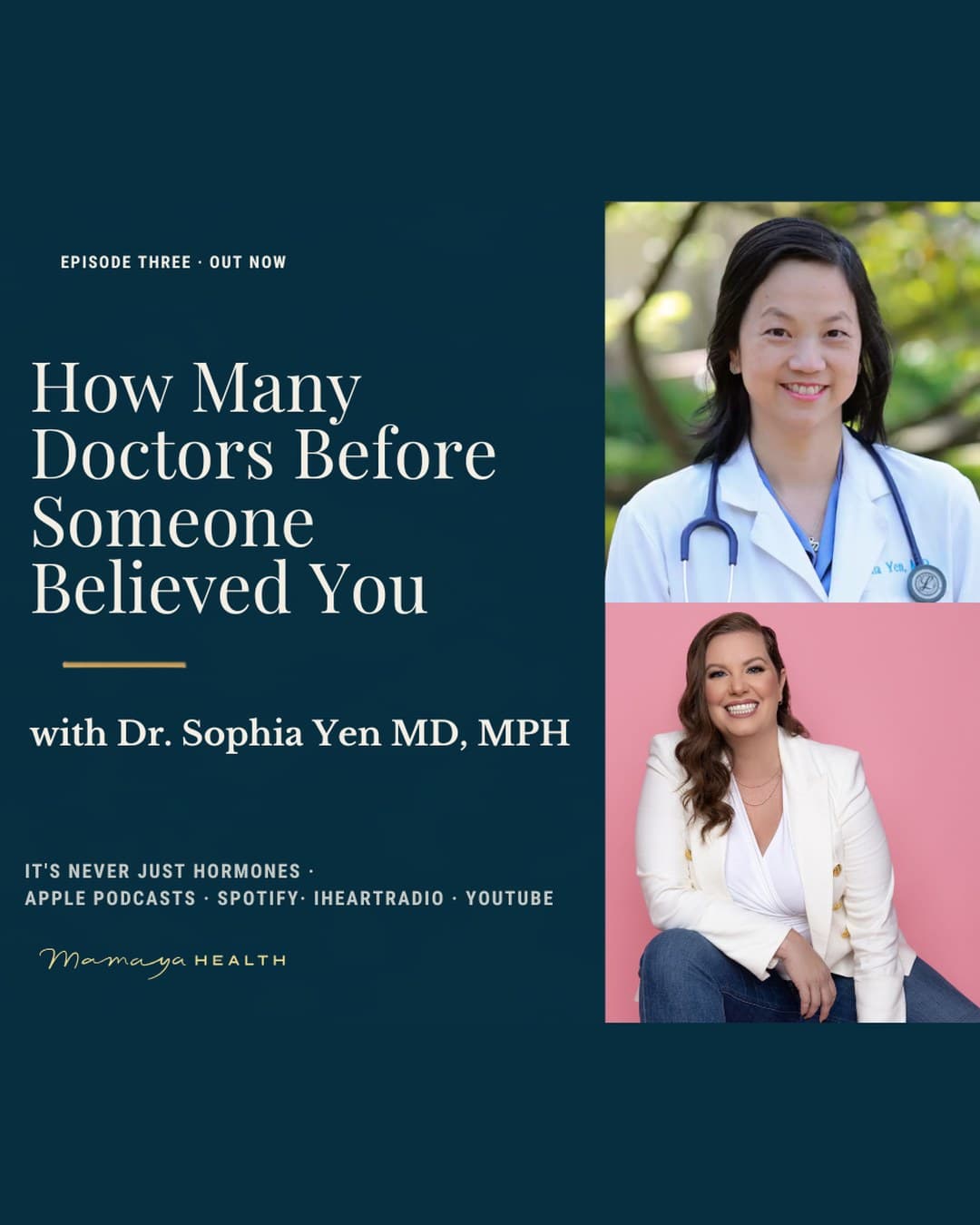
She counted. Eight doctors in four years before one asked the question that mattered: “Where are you in your cycle?”
Dr. Sophia Yen, MD, MPH, MSCP, explains why it takes so many doctors. Only 31% of the OB-GYN residency programs that responded to a recent survey said they had any menopause curriculum, and a twenty-year misreading of one major study is still shaping what doctors are willing to offer.
We talk about what perimenopause actually is (a change in your period, not a number on a blood test), why estrogen affects every cell from your head to your toes, when an antidepressant is the right call and why it shouldn’t replace hormone therapy, what the Women’s Health Initiative really found twenty years later, and what to bring, what to ask, and when to walk away from an appointment.
Find a menopause-trained clinician by zip code: menopause.org (practitioner finder) · hermedicine.org
Mentioned: Estrogen Matters, Dr. Avrum Bluming
Have a story about a season nobody warned you about? Share it here: [story form link]. Anonymous is fine, and nothing airs without your okay.
Find care built for your season: mamayahealth.com
Sources: Allen JT, et al. Menopause, 2023 (menopause education in OB-GYN residency). Chlebowski RT, et al. JAMA, 2020;324(4):369–380 (WHI 20-year follow-up).
Disclosure: Dr. Yen is CEO and co-founder of Pandia Health. This episode is not sponsored.
This podcast is education, not medical advice. If you’re in crisis, call or text 988. If you’re pregnant or postpartum, Postpartum Support International can help: 1-800-944-4773 (call or text).
Full transcript
Show
E2 So Many Doctors: From Mamaya Health, this is It's Never Just Hormones. I'm Amy Green. I'm a therapist. I've spent two decades in the chairs sitting with women who had been told that it was stress or hormones or just what motherhood feels like, and watching them fall through the cracks of a system that kept answering a different question than the one that they were asking. Eventually, I stopped waiting for that system to fix itself. And built the one I wish I could have had to refer them to. This show works the same way that room did. Every episode starts with a woman's story told on her terms. Then someone who knows this territory helps me trace it back to what was actually happening in her body, in her mind, and in the system around her.
She counted. That's the part that stays with me. At some point she started keeping count. Eight. Eight doctors in four years. Doctor one said stress. Doctor three ordered thyroid labs that came back fine and then never called. Doctor five gave her an SSRI for anxiety. Dr. Eight was an ad locum. 20 minutes, running late. It wasn't even her regular office. And that one asked a question that nobody had asked in four years. Where are you in your cycle? She cried in the car afterwards, because if the answer took six words, somebody could have said them in year one. She isn't one woman. She's a version of a story that I have heard many times with the details changed.
Here's what I've come to believe after years of sitting with women in this season. The earliest signs are almost never hot flashes. It's the anxiety that arrives at a character, or the rage that frightens her, or the word finding that makes a smart woman quietly start to wonder if something is wrong in her mind. It's waking up. In the middle of the night between two and four, and you're wide awake. It's joint pain and itchy ears. Yes, really. It's five symptoms and five referrals and five dismissals. And nobody in the room says the word perimenopause. Today, why it takes so many doctors? What's actually happening in a woman's body in this season? And a 20-year mistake.
That is still shaping what your doctor is willing to offer you. For the past two decades, the medical establishment has ceded the treatment of menopause to alternative medicine. My guest today is Dr. Sophia Yen. She's an MD, an MPH, and a menopause society certified practitioner, which matters, and she'll explain it way better than I can. She's also the CEO and co-founder of Pandia Health. It's a telehealth company that prescribes in this space. They did a poll of Obi Guine residencies today, not like 30 years ago when I graduated, but like today. And only 31% of the residencies that responded said, we have some menopause curriculum. Flip that. 69% of OBGyne residencies have no menopause, perimenopause curriculum.
And who knows what percentage of internal medicine, family medicine residencies have that. And then I happen to gra have graduated from one of the top medical schools in the world and work at one of the top medical schools in the world, a separate one, their competitors. Ask the med student, menopause is hot right now. Are they teaching menopause in medical school? And she's like, no. Maybe if you ask on your family medicine rotation, they might, but zero. hours dedicated to perislash menopause education in four years of medical school for something that will affect a hundred percent of us that were born XX and that 60 to 70 percent of us will suffer and that a medication could help with and I do believe even the 30% that have no symptoms they actually will have their blood, brain and bone affected regardless.
So that's why You have to go through that many doctors. Thank you for sharing all that. I feel like that's just really unbranded sometimes with women's health. What is perimenopause? Like what is it medically? I know that people want to redefine it, et cetera, and fine, but right now, according to the American College of Astetrics and Gynecology and the Menopause Society, which covers North America, it has to be a change in your periods. So many people are like, But you get the symptoms of four-year periods change of blah blah. Just know the current definition is it has to be a change in your period. So it could be heavier, it could be lighter. Like I used to be a five-day girl and now I'm a three-day girl.
Or I used to be a three-day girl and now I'm a seven-day girl. That's just horrifying. So any change heavier, lighter, that counts, plus or minus seven days. So if you used to be every 28 days and now it's every 21 days, that's a change. If you used to be every 28 days and now it's 35 days, that's a change. So early perimenopause and know that there's early perimenopause and late. It doesn't mean you got it early, got it late, just the first early part and then the late part. Early perimenopause is change in periods. Late perimenopause is been greater than 60 days, no period. And then those of us, you know, going into perimenopause with stable hormones, using the birth control pill, patch ring, sometimes the IUD, sometimes the implant, then you don't know when your last period is.
Because I use the birth control pill for 17 years to not have a period. Because if you're not trying to catch an embryo, why are you building up and down and bleeding every single month? So I just turn them off. And so then how do I know? Cause the definition is one year without a period. Well, and so much confusion. Do you think that the definition as you describe it today of what is perimenopausmetically, do you think that medical definition is actually too narrow? I think that we may find in the future that there are lab tests that could get us there. Or if we have a continuous hormone monitor, like we now have continuous glucose monitor, yes.
Then we will be able to redefine it. And there is somebody that states that they have that right now, but I'm concerned because I really don't think you can get it unless you get blood. So because you cannot get it from temperature, heart rate, blood pressure. No. This is a hormone. You need to get blood, or at the very least, pea, but and pea is delayed by a couple hours or whatnot. I also believe that. There you all need to look at the difference in costs and then is it reproducible and is it trusted by medical societies? The brain, the bone, and the body. That research is newer, but it's profound research. Can you give us a little bit of insight on what we've learned and why those interventions, when we start them earlier, matter so much for longevity?
So I think it's important for people to realize and think about it from the biological perspective. So the way I think of it simplified. Is it around 52? Your body's like, thank you for your service. Wish you the best. Deuces. I'm taking away your estrogen. Goodbye. You've made babies, you've grandmaud, thank you. Anything beyond 52 is gravy. And so, like four to six years before that, 47 is the average age of perimenopause, but everything is plus or minus five. And minorities may start longer and minorities may last longer. So, like, you know, 47 down to 42. Anything under 40, people are just trying to scare the crap out of you and trying to make money off of you.
Certainly that's possible, but in general, not before 42. Okay. your body takes away the estrogen and all this bad stuff starts going down. So you start losing your bone density and you lose up to 20% of your bone density during this perimenopause, menopause kind of state, 20% of your bone density, which then puts you at risk. For osteoporosis, obviously, osteopenia and fractures. And if you have any kind of weird fracture, that's a sign of osteopenia, if not osteoporosis. The sad part is the current state of things, because insurance is evil and doesn't want to pay for anything. They don't generally pay for a DEXA until you're 65. And 65 is very far from 47, 42, or 50 something, right?
It's not preventative when you're shaking it at 65. This is the part that made me angry. The scam isn't covered by insurance until 15 years after it starts. For the cardiac part, I'm also an obesity expert. And so when I heard that when you take away estrogen, your arteries no longer dilate, and so they're skinny, and so they can fill up with blood clots more. Your LDL shoots up. We become insulin resistant, which means you're at risk for diabetes, but that means also your triglyceride shoot up. So what's gonna happen? Heart attack, strokes in the brain or mini dementia. And then also just for women in general, when you take away the estrogen, the fat goes to your waist, which is not cool because your skirts and your pants don't fit anymore.
But again, from the obesity's perspective, it also goes to your heart. And it goes to your liver. And as an obesity expert, I'm like, heart, liver? If that's what happens, then you need to put the estrogen back. However, know that the four FDA-approved reasons for HRT are hot flashes, night sweats, genito-urinary symptoms, and we can go over that later, and at risk for osteoporosis. And so you can invoke the at-risk, high-risk. moderate risk for osteoporosis if you are a small framed woman, if you're a person of color who's lactose intolerant and sucks at getting your calcium and vitamin D, if you have a sister, an aunt, a mom that have osteoporosis, all of these qualify you as at risk for osteoporosis and you just need to invoke that to do it.
But notice how I didn't mention cardiovascular disease, stroke, diabetes. And we need a medical association to say these are the indications. They say we don't have the evidence, we don't have the science to use it as a prevention drug. But I personally feel that the science is there, but doctors don't want to get sued. And so we need somebody to issue a statement, the FDA or American College of Obsections and Gynecology, or American Endocrine Society, or the Metopause Society. And then we will feel comfortable writing these drugs so we don't get sued. Notice what she just described. It wasn't a doctor who doesn't care. It's a doctor who's waiting for permission. Basically, what you've said is the earliest symptoms are almost never necessarily hot flashes.
Their early signs and symptoms might be changes in period, crazy changes in our hormones. And also some of the wild symptoms, like from itchy ear to like my labia isn't there anymore, all somehow tied back to our estrogen, our progesterone, and these massive changes that are occurring in our body. That have significant impact and implications for us. Yeah, just sum it up there. Estrogen affects every cell in our body, from our head down to our toes. And one thing that I love, my husband's like, yeah, estrogen makes everything dry. And I was like, You're right. It makes your skin dry so that when you brush up against something, you now rip and you get tears and you get bruises, it makes your eyes dry.
It makes your ears dry, that's the itchy ears. It makes your vagina dry, that's the itchy, painful vagina. It makes your urethroat dry up and that's the increased risk of urinary tract infection. And so just note that estrogen affects your brain cells, it affects every cell, and that's why every physician should get at least one hour in medical school education. And so know that there are like 80 to 100 symptoms. Of perislash menopause. That's wild. Talk to me about how those early changes in hormones might be mislabeled or misread as psychiatric symptoms. Yes. So a recent paper said when you have this new onset depression, anxiety, they would put them on an antidepressant rather than being like, ooh, you're at the stage of life where one, you're sandwiched and you have to deal with both your parents' old age and your children.
And life is stressful, and you're at work and you're the top of your game, but you're getting brain fog from your perislash menopause, and it's deeply embarrassing when you're trying to find a word and you just can't find it. So, like a lot of stress going down, right? I want to be mindful here. I'm not anti-psychiatry. I'm a therapist. Plenty of women in the season have depression that deserves treating it on its own terms. What I am against is the either-or. Sometimes It's anxiety. Sometimes it's perimenopause. Very often, it's both. Integrated care means that nobody has to pick wrong. If you are having major depression, then absolutely do both at once. But if it's just a little bit of tired, can't sleep, can't concentrate, and your periods are weird and you're the right age, then maybe start with the HRT.
Give that, you know, a month. And if that isn't, then SSRIs. Yeah. It's a it's a both. It's a both and. You're MSCP certified. What does that mean? And what does evidence actually say about hormone therapy in 2026? So that is menopause society certified practitioner. The menopause society is a nonprofit and it's comprised of academic, all these famous colleges. evidence based and they have a position statement on non-hormonal therapy, what the evidence shows, what it does not show. Does acupuncture work? Does acupuncture not work? Does cognitive behavioral therapy work? Does black kohosh work? Does Ashwagandha work? No and no on those latter two. And and so I had to study and anyone else who takes this test has to study all the latest position papers and pass a hundred question test. on menopause and the treatment of perislash menopause, different stages of perimetopause, all the medications, all their different formats.
What are the implications of local estrogen versus systemic estrogen? What is the evidence on progesterone? What does it help? What is the right dosage, etc. That's what it means if you have a menopause society certified practitioners. They know the latest and greatest are up to date on the position papers and hopefully are practicing evidence-based. medicine. That's an MSCP. However, you may need to unfortunately, and you shouldn't, I mean, really the doctor should know, know the latest and greatest on the Women's Health Initiative. So this was a research study in 2002 that took down all of HRT for Western medicine, let's say, for the past two decades. And that study you need to present to your doctor if they're like, estrogen is bad, estrogen caused breast cancer.
No. We now have 10 and 20 year follow-up of women that were in that study, the largest study ever of a randomized clinical trial of HRT. So usually we give estrogen to help all this bad stuff. We give progesterone to block estrogen's effect on the uterus, because estrogen stimulates the uterus to grow. And if you don't have progesterone, then it will grow and cause cancer and weird bleeding. So you gotta give the progesterone. But one of the top surgeries in women. is hysterectomy. So there was a group that did not have any uteruses and so they didn't give them progesterone. And so we call them the estrogen only arm. And in this group that got conjugated equine estrogen and that's a different discussion, but horse estrogen?
Pregnant mares urine, that estrogen had decreased breast cancer by 22%. So now we believe it's not the estrogen that increases breast cancer that was reported about this study. That scared everybody from HRT for 20 years, we now think it's the synthetic progesterone. And the synthetic progesterone they used in the study was madroxy progesterone acetate, which we no longer use for HRT. We now use bioidentical, micronized, FDA-approved, FDA-tested, comes in a pill, progesterone. So if your doctor says or provider that estrogen leads to breast cancer. that is a doctor who's not up to date on the latest and greatest. For 20 years, most of us, myself included, we carried one sentence away. Hormones cause breast cancer.
Think about who that costs. It's not the women in the study. It was in fact the generation after them. Every woman who walked into an office between 2002 and now and was told no by someone who genuinely believed that they were protecting her. And then the other question to ask your provider to see if they know their latest stuff is how long can I stay on this? And if they say 10 years, then fire that doctor or educate that doctor. Because if I put you on this for 10 years and then I take it away, what's gonna happen? All the bad stuff that was happening that we gave you the estrogen to prevent is gonna happen unless all of a sudden your body just manifest estrogen.
And there are people working on an artificial ovary or extending the lives of our ovaries. But until that happens, we need to put it back. So if you ask any menopause society certified practitioner physician, I'm pretty sure 90, 95% of us are gonna say, you're gonna find this patch on my dead body. I love that so much. So here is the practical version in her words. There's two questions. Does estrogen increase the risk of breast cancer? And how long can I stay on this? And if the answers are yes and 10 years, you have learned something useful about that appointment. And there's a finder, menopause.org. Certified care exists, and you can search for it by zip code.
Hormone therapy also is not right for everyone, and it's not without risk. What you just heard is a real argument. made by a certified practitioner that the pendulum swung too far. When a woman's preparing to walk into an appointment, what do you recommend that she tracks? What do you recommend that she says that she asks for? Yeah. So what you should bring to that is have your periods gotten irregular and weird? Cause that is critical for the definition of perimenopause. So like I said, it needs to be heavier or lighter or it needs to be plus or minus seven days from usual or you haven't had it for two months. don't be going in there demanding blood tests because if you are in this perimenopause state, then the doctor will be like, you don't know your stuff, because getting a lab test is a snapshot in time.
It's not useful. They may take a blood test for thyroid because in our 40s is when autoimmune thyroid disease shows up. And if you have low thyroid, then you're gonna gain weight, your periods are gonna get weird, your hair is gonna be messed up. Very similar symptoms to perislash menopause. So they they absolutely should check a thyroid. They might check for anemia. Know that the number one cause of anemia in a menstruating person is menstruation. So bring your period weirdness. If you don't have period weirdness, they might not listen to you. Then bring your list of symptoms. The classic ones are hot flashes, night sweats, genito-urinary symptoms, and at risk for osteoporosis. If you can do any of those, you just bought yourself some HRT.
Outside of that, then you're asking the doctor to go off label and risk getting sued. So that's gonna be a harder battle to play. So so just know what you're asking of your doctor. Can you tell me what made you decide to work around this particular area of specialization? I started with a passion for preventing unplanned pregnancy. So we started with birth control. And then I hit menopause. And all my friends were like, menopause. And I'm like, yes, I will find the best treatment for me and I will give it to all of you. And I realized that, you know, birth control is estrogen and progesterone, both synthetic. And then HRT is generally bio-identical estrogen, progesterone, with one-tenth.
120th the strength and far fewer contraindications. So an example is birth control, migraine with aura, can't have estrogen, but bioidentical transdermal estrogen is okay. Blood clots can't have synthetic ethanol estradiol birth control pills, but bioidentical transdermal estrogen has not been shown to increase blood clots, so that's okay. And then anyone of any age, breast cancer or not breast cancer, can have vaginal estrogen because vaginal estrogen is not absorbed systemically, it's just down here and it helps with the genitourinary symptoms, which again are painful sexual relations, pain, itching, and pain and itching of the urethra as I mentioned, you take away estrogen, it dries up and it increases your chance of urinary tract infection. So I I did it because women deserve excellent care, and women deserve to not be gaslit.
Last thing. I asked Dr. Yen what she'd say to the woman who has felt like a shell of herself for two years. And she started to believe that this is just who she is now. Hashtag stop sucking it up. We have drugs and science, evidence-based, randomized clinical trials, and doctors and academic institutions practicing evidence-based medicine to help you. You don't have to be Tired, irritable, angry, all of that. And and just talk to the women that have used it and have benefited from it. Thank you so much for sharing your incredible expertise with us. Thank you so much for having me. Back to the woman who counted to eight. I don't think the eight were bad doctors.
I think seven in ten of them were trained in programs that never taught this, working from a study that was misread before some of them finished school. The answer to how many doctors should be one. If something in this found you where you live, here's what I want you to know. What you're carrying is real, it has a name, and it is more treatable than anyone has told you. At Mamaya, we measure every woman's progress, every single session, because the only way to know care is working is to actually check. Most women who come to us in the clinical range finish below it, and most of that change lands inside 12 weeks. Finding care built for your season takes one step.
Visit us today at memayahealth.com or visit the resources in our show notes. If you're in a crisis, call or text 988. If you're pregnant or postpartum, Postpartum Support International is a great resource. And if there's a story you've never told about this season or any season nobody warns you about, the form is in our show notes. Anonymous is fine. Nothing airs without your okay. I confirm it with you first, every time. It's never just hormones, it's from Amaya Health. Our senior producer is Emily Seiner. New episodes twice a month. I'm Amy Green.